In children 6 to less than 18 years old with obesity due to BBS
IMCIVREE helped reduce weight and hunger measures over 1 year


Actor portrayals
IMCIVREE helped children aged 6 to less than 18 years reach steady and long-lasting reduction in weight measures
IMCIVREE was studied in two first-ever Phase 3 clinical trials that included children and adults with obesity due to BBS. In the year-long study of people aged 6 and older with obesity due to BBS, 16 children aged 6 to less than 18 years old were included. All children in the clinical trial had to have a certain body mass index (BMI) and weight in the 97th percentile or higher.
People 6 years and older taking IMCIVREE saw an ~8% average reduction in BMI* over the course of 1 year.
*People taking IMCIVREE had general improvements in other areas. Blood pressure, lipids, and waist size improved with IMCIVREE. Due to a limited number of people studied and the lack of a control group in the study, these treatment effects could not be accurately measured.
Reduction in weight measures with BMI Z-score in children (aged 6 to less than 18)
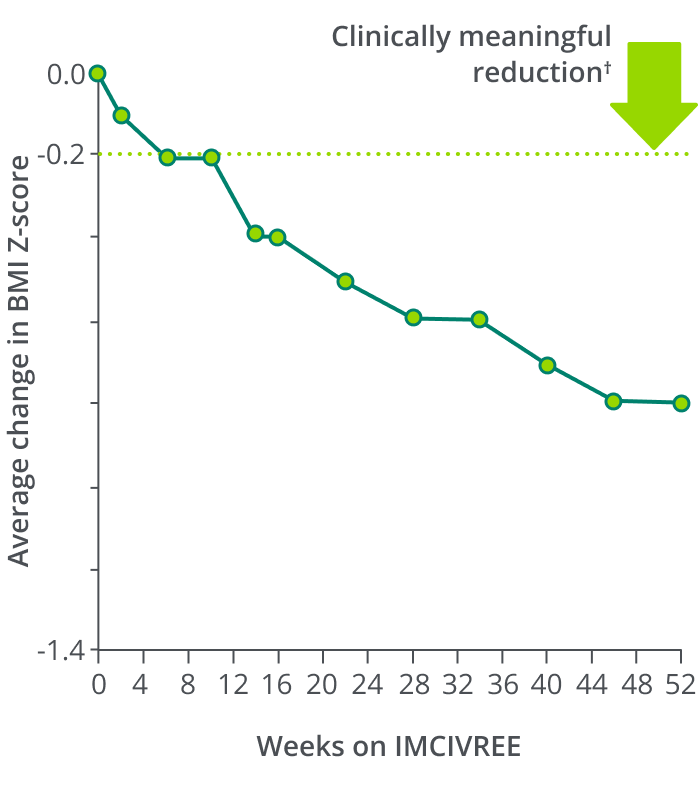
- Children saw an early meaningful reduction in weight measures†
- Children continued to see a reduction in weight measures by BMI Z-score over the course of their first year of treatment
A BMI Z-score was used to measure the reduction in BMI in children. BMI Z-scores are reliable measures of weight in children who are still growing because they take into account height, age, and gender.
†A clinically meaningful reduction is generally defined as a reduction of greater than or equal to 0.2 in BMI Z-score.
No change to diet or exercise:
In the clinical trial, people were not required to change their diet or exercise routine.
IMCIVREE is the first and only treatment to significantly reduce BMI Z-score in children with obesity due to BBS
Some people chose to continue taking IMCIVREE in a separate long-term clinical trial. After receiving 2 years of treatment, their results were analyzed.
After 2 years of treatment, IMCIVREE helped children maintain meaningful reductions in BMI Z-score.
86%
of children had a meaningful reduction in BMI Z-score over 1 year
100%
of children had a meaningful reduction in BMI Z-score after 2 years
- There was a 0.72 average reduction in BMI Z-score
- 12 children between the ages of 6 to less than 18 years were evaluated as part of the 2-year follow-up study
IMCIVREE reduced the severity of obesity in children living with BBS
You may be more familiar with viewing a child's growth on a chart that compares how their height and weight match up with other children the same age. This is called a growth chart. The growth chart here shows a representation of a 12-year-old girl with obesity due to BBS. It demonstrates how IMCIVREE might help to lower her BMI after 1 and 2 years of treatment, based on results from the IMCIVREE clinical study.
Representative growth chart for a child with obesity due to BBS before and after IMCIVREE
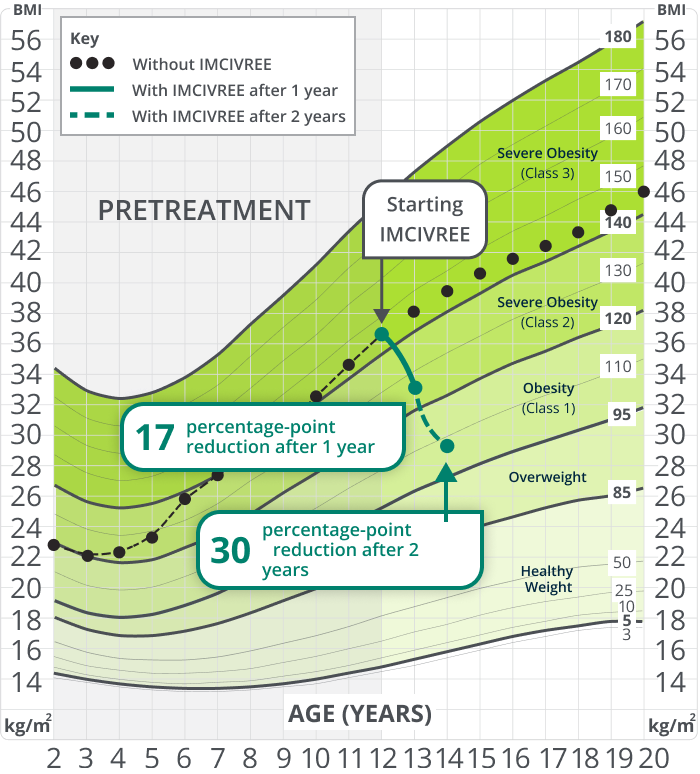
After 1 and 2 years on IMCIVREE, she would see a 17 percentage-point and 30 percentage-point reduction in BMI as a percentage of the 95th percentile, respectively.
With IMCIVREE, her weight-gain trajectory drops down to obesity (class 1). Without IMCIVREE, she would likely remain in the severe obesity (class 3) category as she ages.
Not an actual patient. Growth chart is based on females 2 to 20 years of age and is for illustrative purposes only.
Long-term treatment with IMCIVREE helped children achieve and maintain a healthier BMI.
IMCIVREE provided reduction in hunger scores early and continuously throughout treatment in people 12 years and older
The effect of IMCIVREE on reducing hunger was studied in 14 people 12 years and older living with BBS who could self-report their hunger.
- They completed a questionnaire every day for 1 year to determine changes in their hunger
- People scored their hunger on a daily basis using a scale from 0 to 10
IMCIVREE reduced the most severe feelings of hunger in people 12 years and older
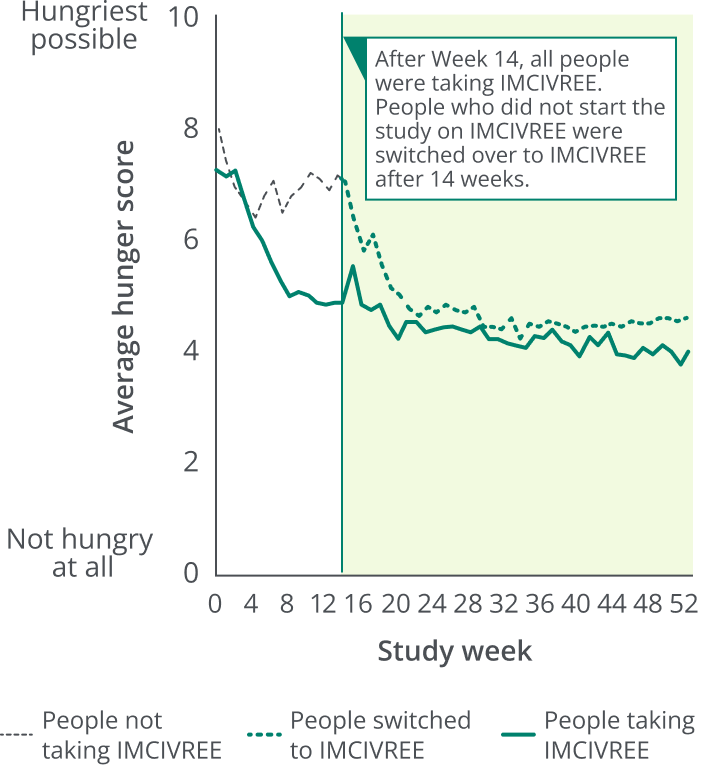
A majority of people 12 years and older reported a reduction in hunger within weeks of starting IMCIVREE.
He is no longer digging through the fridge or garbage, so we do not lock them anymore. He isn’t asking for food constantly between meals and snacks, and I sometimes find myself realizing it’s been a few hours and asking him if he’s ready for a snack.
– Caregiver of a patient living with obesity due to BBS
The change in his hunger has cascaded into many positive life changes for all of us. There's less agitation and anxiety over hunger or family meals. This is simple normalcy for many families, but for us, they're moments I'll never take for granted.
– Caregiver of a patient living with obesity due to BBS
Individual results may vary.
Quality of life, a measure of a person's day-to-day well-being, was evaluated in people with obesity due to BBS
As part of this study, people with BBS were asked to evaluate aspects of their quality of life. For children aged 6 to less than 18 years old, questions in the survey measured:
- Physical ability in daily activities
- Emotional state
- Social needs
- Ability to perform at school
Higher survey scores indicated improvement to daily life. Lower scores indicated a decrease.
On average, people reported higher scores after 1 year of taking IMCIVREE.
Although general improvements were measured, the number of people was too limited to make clear conclusions. The trial was also not set up to determine whether these changes were because of IMCIVREE.


The impact of IMCIVREE
Learn more about the impact of IMCIVREE from healthcare providers and people on treatment.
Resources and support tailored to your child's journey
As a caregiver, you may need clear information to help you prepare for doctor visits or support in understanding your child's condition. Your Rhythm lnTune Patient Education Manager (PEM)‡ is here with personalized educational resources.
‡Patient Education Managers are employees of Rhythm Pharmaceuticals and do not provide medical care or advice. We encourage you to always speak to your healthcare providers regarding your medical care.
Use our Doctor Discussion Guide to start the conversation about treatment with IMCIVREE.
Learn about the possible side effects
of IMCIVREE.